

- PM Proposes Five Urgent Steps to Resolve Rohingya Crisis |
- Govt Appoints Indonesian Firm to Operate Cox’s Bazar SPM |
- ADB lowers Bangladesh’s growth forecast to 4 % in FY2027 |
- El Niño Tests Global Readiness for a Changing Climate |
- Dhaka's air quality recorded moderate on Wednesday morning |
Israel Launches West Bank Settlement, Threatening Two-State Plan
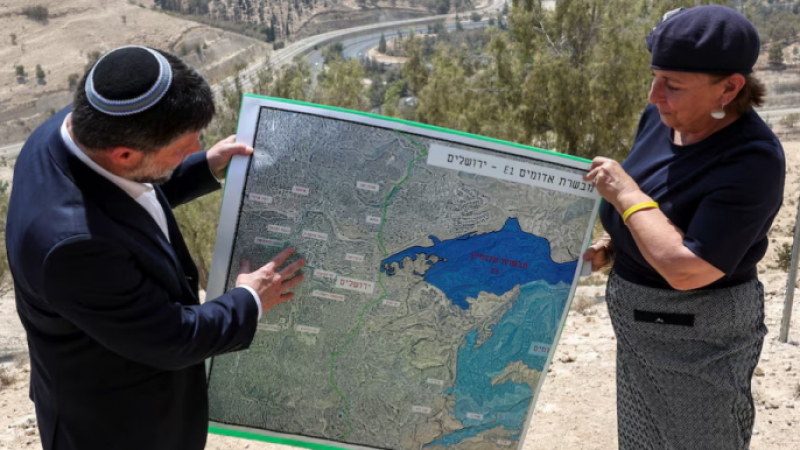
Israeli Finance Minister Bezalel Smotrich and a woman hold a map that shows the long-frozen E1 settlement scheme, that would split East Jerusalem from the occupied West Bank, on the day of a press conference near the Israeli settlement of Maale Adumim, in the Israeli-occupied West Bank, August 14, 2025.
Israeli Finance Minister Bezalel Smotrich has announced the start of work on a long-delayed settlement in the West Bank, a move his office said would “bury” the idea of a Palestinian state by dividing the territory and cutting it off from East Jerusalem.
The plan has drawn strong condemnation from Palestinian authorities, allies, and campaign groups, who describe it as illegal and a severe threat to peace efforts in the region.
Smotrich, speaking at the planned site in Maale Adumim, said the project had the backing of Israel’s leadership and claimed that it would respond to any international recognition of a Palestinian state with tangible “facts of houses and neighbourhoods.”
The United Nations urged Israel to reverse its decision, warning that settlement construction would end prospects for a two-state solution and contravene international law.
Construction at Maale Adumim was previously frozen in 2012 and again in 2020 due to objections from international powers concerned about its impact on peace prospects. Resuming the project could further isolate Israel diplomatically, as some Western allies consider recognising a Palestinian state in response.
The plan calls for building 3,401 homes for Israeli settlers between an existing settlement and Jerusalem. Activists warn that the development will fragment Palestinian territory and entrench occupation, while Palestinian officials have called on the United States to pressure Israel to halt construction.
European Union and British officials have reiterated that annexing or altering territory without a political agreement is illegal under international law and undermines the two-state solution.
Peace Now, an organisation monitoring settlement activity, said infrastructure work could start within months, with home construction beginning in about a year. They warned that the plan threatens both Israel’s security and any chance of lasting peace.
Approximately 700,000 Israeli settlers currently live among 2.7 million Palestinians in the West Bank and East Jerusalem. Most world powers consider settlement expansion illegal and a major obstacle to the viability of a Palestinian state alongside Israel.
Israel defends its settlements based on historical, religious, and security reasons, but international consensus largely regards the West Bank as occupied territory, with settlement expansion further undermining efforts to achieve a peaceful two-state solution.