

- Dhaka’s air quality moderate on Sunday morning |
- Special prayer held at DU on 45th death anniv of Ziaur Rahman |
- 55-year-old dies in Chuadanga as fibrous mango bit blocks throat |
- Dhaka's air quality ‘moderate’ during Eid holiday |
- Thousands of tourists flock to Kuakata during Eid festival |
UN Reforms Spark Fears of Job Cuts, Deportations, and Turmoil
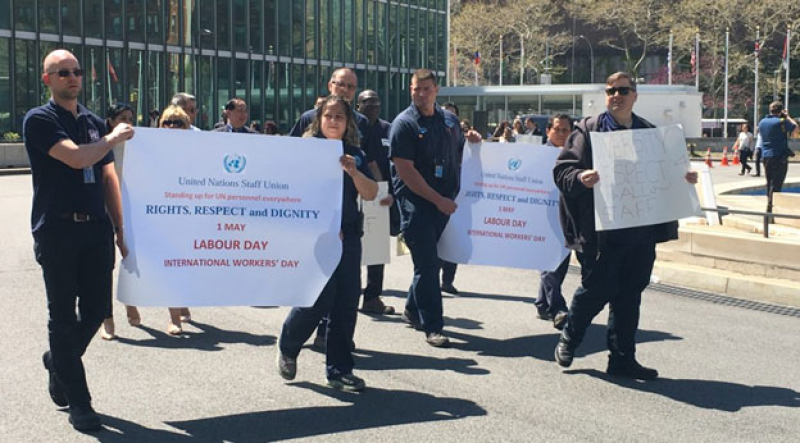
The United Nations Staff Union is the labor union representing New York Secretariat Staff, Locally Recruited Staff in the field, and Staff Members of UN Information Centers.
The 193-member General Assembly, the UN’s highest policy-making body, will make the ultimate decision on the proposed restructuring, which includes staff cutbacks, the merging or elimination of departments, and relocating UN agencies from high-cost to low-cost locations.
Perhaps one of the biggest fears is that thousands of UN staffers, who are neither permanent residents nor US citizens, along with their families, will have to return to their home countries after living in the US for years—or even decades—because they will lose their UN visa status.
UN spokesperson Stephane Dujarric told reporters on August 25 that the Secretary-General will present a revised budget to the Fifth Committee in the coming weeks. But he described the proposed cutbacks as “some painful staff reductions.”
“These proposals will be presented to the General Assembly, and it will be Member States who will have to take those decisions,” he noted.
Stephanie Hodge, a former staffer at UNDP (1994–1996 & 1999–2004) and UNICEF (2008–2014), told IPS that UN “reform” seems to mean chopping 20 percent across the board, “as if leadership could be measured with a lawnmower.”
“What really happens, of course, is that the bullies, sycophants, and kick-up, kiss-down survivors cling to their posts, while the technical staff — the ones who actually deliver — are the first out the door,” she said.
The humiliation for staff is real, she pointed out. Many spend months walking past the same UN offices where they once worked, waiting for a promised callback that never comes. And now, thousands in New York who are not U.S. citizens or permanent residents face an even harsher fate: pink slips, deportation papers, and decades of service dismissed in the name of “efficiency,” said Hodge.
“The irony is brutal: an institution founded to protect rights is now poised to trample on the rights of its own. Families uprooted, livelihoods erased, duty of care abandoned. This isn’t reform — it’s institutional hypocrisy, and it hollows out the very values the UN claims to stand for,” she argued.
The UN preaches “leave no one behind.” Apparently, that excludes its own, declared Hodge, an international evaluator and former UN advisor who has worked across 140 countries and writes on governance, multilateral reform, and climate equity.
A former UN staffer told IPS: “I know it would be almost inhumane to abruptly disrupt people’s lives midway through their careers and their children’s education, unless adequate compensation is provided to those affected. Well, we still don’t know what the UN is planning to do.”
Meanwhile, a new report from the World Health Organization says it anticipates losing 600 staff members at its headquarters in Geneva due to reductions in its 2026–2027 budget, WHO Director-General Tedros Adhanom Ghebreyesus wrote in a letter to staff, according to Devex.
“With a 21% reduction in the 2026–2027 budget, we are now realigning our structures with our core mandate,” Tedros wrote, outlining WHO’s ongoing restructuring in response to donor funding cuts.
“Some activities are being ended, others are being scaled down, and those most directly linked to our mission are being maintained. At headquarters, based on the final approved structures, we anticipate approximately 600 separations,” he said.
Asked for her comments, Dr Purnima Mane, ex-President and CEO of Pathfinder International and former Deputy Executive Director (Programme) and UN Assistant-Secretary-General (ASG) at the United Nations Population Fund (UNFPA), told IPS that UN reform has generally been seen as a welcome process to streamline its functioning and achieve its objectives more efficiently.
However, she noted that reform should serve the organisation in meeting its goals and benefitting all stakeholders, including staff. When driven mainly by financial constraints, the process becomes questionable.
“Proposed organisational restructuring driven largely by reduced funding runs the risk of sacrificing human considerations and impacting the broader goals of the UN,” she warned.
While the final decision lies with the General Assembly, she explained that the restructuring will likely include staff cutbacks, the merging or elimination of some departments, and the relocation of agencies from high-cost to low-cost destinations.
Discussions suggest the UN may consider early separation programmes (voluntary departures), which may appeal to some staff nearing retirement. But more drastic options, such as merging or eliminating departments and relocating agencies, will pose major logistical challenges.
For staff in the US who are neither citizens nor permanent residents, these changes will be especially difficult. Families who have lived in the US for years may lose health insurance and retirement packages, with benefits often insensitive to rising living costs in other countries.
“Finding alternative employment with their immigration status will be even more difficult for the ex-employees, especially in a generally tough job market. While severely handicapping staff welfare, these steps would also deprive agencies of the skill sets needed to perform effectively and achieve the UN’s aims,” she said.
While cutbacks are undoubtedly painful for the organisation, they are most painful for staff and their families. Often there is a perception that UN employees are “privileged,” financially and otherwise, so their welfare is dismissed as a minor concern.
Dr Mane urged Member States to weigh the human costs as well as the broader impact on the UN’s mission.
“Focusing on major structural changes and staff reductions at the cost of morale — particularly at a time when a uniting, well-functioning body is most needed in a volatile world — could severely jeopardise what the UN has so far achieved, and endanger what it aims to offer in the future,” she declared.