

- Hadi's condition 'very critical' after bullet causes 'massive brain injury' |
- DMP intensifies drive to arrest attackers of Hadi |
- Tarique terms attack on Hadi a conspiracy against democracy |
- Man held for tying, beating up youth on theft suspicion in Gazipur |
- Sajid (2) lifted after 32 hrs from deep Rajshahi well, not alive |
UN Mission Exit Marks Milestone in Iraq’s Transition
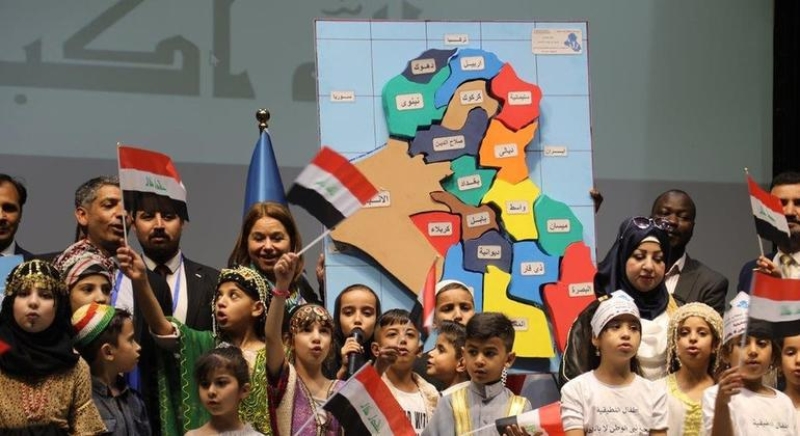
Iraq’s rich cultural diversity demonstrates how young children can inspire adults to respect differences, live in harmony, promote tolerance and respect for each other. (2022)
After more than two decades working alongside Iraq through war, political upheaval and the fight against ISIL terrorists, the UN Assistance Mission for Iraq (UNAMI) will end its mandate on 31 December — a closure its top official describes as “honourable, dignified and earned”.
In an interview, Mohamed Al Hassan, Special Representative of the Secretary-General (SRSG) and UNAMI chief, said the mission’s end reflects how far Iraq has come since it was established in 2003, when the country was emerging from decades of dictatorship, regional wars and the terror wrought by ISIL, known more widely in the Middle East as Da’esh.
“When UNAMI started, Iraq was a very different place from today,” he said. Just days into the mission in August 2003, the UN came under attack at its Baghdad headquarters, leaving 22 staff members dead and more than 100 wounded.
Today, a new era has dawned. With the sacrifices of Iraqis first and foremost, and with international support — particularly from the United Nations — Iraq believes it is ready to move into a new phase, solidifying its sovereignty and territorial integrity.
Over the years, UNAMI has provided critical support across a wide range of areas, including advising the government on political stabilisation, promoting inclusive national dialogue and supporting community-level reconciliation in conflict-affected areas. It has also played a central role in electoral assistance, helping Iraq conduct multiple rounds of local and national elections.
Security Turnaround
Among UNAMI’s most significant legacies, Mr. Al Hassan said, is the dramatic improvement in security. He noted that Iraq would have had no way to defeat Da’esh without the help of the United Nations and the international community, but emphasised that it was ultimately the courage and resilience of Iraqis that reversed the extremist group’s advances.
The country, however, still feels the long-term impact of conflict. Roughly one million Iraqis remain internally displaced, including more than 100,000 Yazidis still living in camps after unimaginable suffering at the hands of Da’esh.
UN Secretary-General António Guterres will travel to Baghdad to join Iraqis and the diplomatic community in marking the mission’s closure — an event he described as a clear signal that the task has been accomplished.
Democratic Progress
Mr. Al Hassan said Iraq’s recent political developments underscore how dramatically the country has stabilised. Parliamentary elections held in November, which UNAMI supported, were widely viewed as among the most credible to date. With a voter turnout of 56 per cent, they also demonstrated renewed public engagement.
“It was the fairest, freest and most peaceful election,” he said. “When you see an election that fair and democratic, you know there is belief in a new Iraq.”
Many displaced Iraqis remain unable to return home, particularly to the Yazidi heartland of Sinjar, due to destroyed infrastructure and unresolved security issues.
“I hope they will have the time, resources and support to return to the homes they were displaced from,” he said. “It’s about time.”
A Gender Lens
Advancing women’s rights has been integral to UNAMI’s mandate, and Mr. Al Hassan said Iraq must continue that work long after the mission departs.
“Yes, Iraq today is much better than before on women’s rights,” he said. “But violence against women has unfortunately increased.”
He stressed that sustainable progress must come from within. “We want Iraqis to be the sponsors and advocates of women’s rights — through Iraqi law, Iraqi protection and Iraqi legislation,” he said. “At the end of the day, it is about protecting their own people.”
A major pillar of UNAMI’s mandate has been the promotion of human rights, including judicial and legal reforms, protection of vulnerable communities, and advancing the rights of women and minorities. These responsibilities have shaped the mission’s work up to its planned closure in December 2025.
As Iraq prepares to take its seat on the UN Human Rights Council, Mr. Al Hassan said the country must ensure full protection for women, youth and minorities, while safeguarding freedom of expression.
UN Presence Remains in Iraq
While the political mission will close, Mr. Al Hassan emphasised that the UN’s broader presence in Iraq will remain unchanged. Specialised agencies, including UNICEF, WHO, IOM and UNDP, will continue operating in the country, alongside international financial institutions.
With significant oil reserves and a large economy, Iraq is not seeking aid, he noted. “Iraq does not need charity; it needs the support and friendship of the international community.”
Calling Iraq a “success story” in a turbulent region, Mr. Al Hassan urged the international community to give Iraq the space and support it needs to succeed.
UNAMI’s departure, he stressed, does not mark the end of the Iraq–UN partnership, but the beginning of a new chapter.