

- Islami Andolan to Contest Election Alone in 13th Poll |
- 3 killed in Uttara building fire; 13 rescued |
- Late-night deal ends standoff: BPL resumes Friday |
- Global Marine Protection Treaty Enters into Force |
- US Immigrant Visa Suspension Triggers Concern for Bangladesh |
Urban Challenges Persist as Interim Govt Falls Short
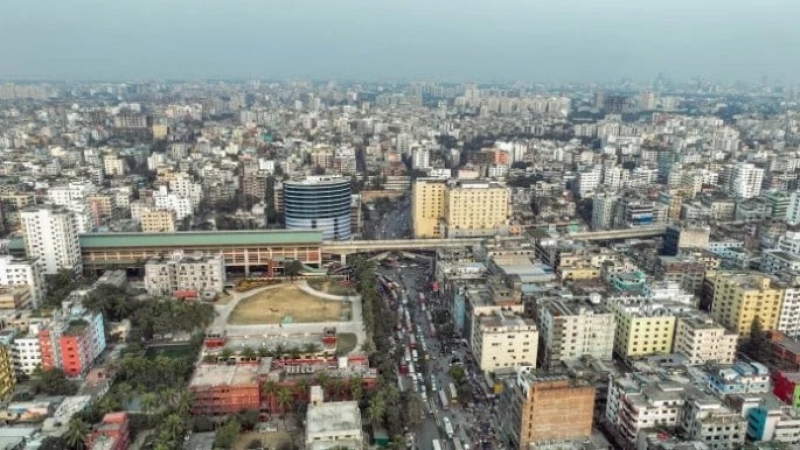
Urban experts have criticised the interim government for failing to take effective action to resolve pressing civic problems in cities, despite introducing a series of laws and regulations over the past year.
The observations were shared on Thursday (16 January) during a webinar titled “Planning, Development, Environment, and Equity of Bangladesh’s Urban Areas in 2025: Citizens’ Expectations and Achievements,” organised by the Institute for Planning and Development (IPD).
Presenting the keynote paper, IPD Executive Director Professor Adil Mohammed Khan said that although the government had formulated laws related to planning, building construction and urbanisation, these had not translated into meaningful improvements for urban residents.
He noted that the occupation of playgrounds and parks remains unchanged, with public access still restricted in many areas. He also said the creation of development authorities in Mymensingh, Barishal and Rangpur would increase bureaucratic dependence, while the government remained silent on forming elected urban governments.
IPD further stated that the authorities failed to ensure exemplary punishment for those responsible for occupying and polluting canals, rivers and other water bodies. The organisation also alleged indifference towards civic movements and attempts to control the media on city and environmental issues, while corruption within urban agencies and political hooliganism remained unaddressed.
Bangladesh Institute of Planners (BIP) President Muhammad Ariful Islam said that even after 55 years of independence, the country still lacks a comprehensive national spatial plan. He added that while fragmented plans exist, implementation is weak and dominated by bureaucrats and administrators, stressing the urgent need to involve professional planners.
Jahangirnagar University Associate Professor Farhadur Reza said there was a wide gap between expectations and achievements under the interim government. He warned that revising Dhaka’s Detailed Area Plan (DAP) would further increase population density and make the city more congested. He also alleged that Rajuk had shifted from development control to housing business activities.
He pointed out that Dhaka has very few parks and said Panthakunja Park was being destroyed even during the current administration’s tenure. Legal protection for parks remains weak, he added, while issues such as waterlogging continue to be neglected.
IPD member Engineer Tofael Ahmed Sajeeb said agencies, including Rajuk, have failed to enforce the Bangladesh National Building Code (BNBC). He warned that the continued construction of unauthorised buildings poses serious risks to civic life and reflects poor implementation of planning and construction laws.
Speakers said that following the mass uprising, citizens had expected strong measures to make cities more liveable, equitable and sustainable. While they acknowledged the approval of the National Urban Development Policy-2025 and the Spatial Planning Ordinance as positive steps, they said effective initiatives were still absent in major cities, districts and municipalities.
They alleged that Dhaka’s DAP was changed under pressure from business groups and that the government failed to act against encroachment of rivers, canals, wetlands and water bodies, as well as polluting industries. No effective measures were taken to reduce traffic congestion, waterlogging or noise pollution, they added.
The speakers also said the absence of ward councillors weakened local-level engagement, leaving communities excluded from addressing neighbourhood problems. As a result, hardships have increased for low-income and marginalised residents.
They concluded that the next elected government must prioritise effective planning, integrated urban initiatives, development management and public participation, rather than focusing solely on large-scale projects.